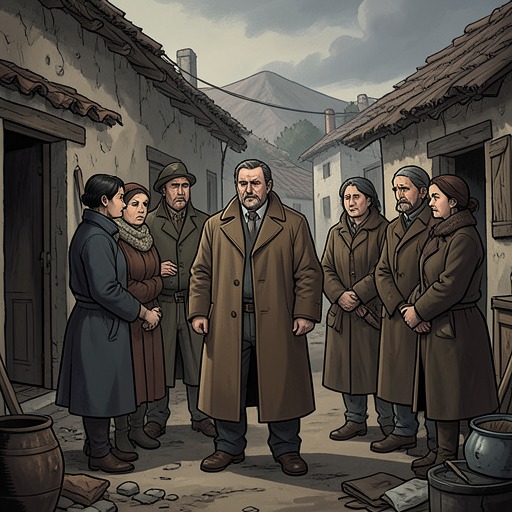
Hig Continues Helping a Mennonite Family
The Dog StarsHig’s continuing assistance to the Mennonite families is a practical, recurring form of cooperation in a world where fear and self-protection have become ordinary. He patrols to their creekside settlement, answers their calls for help, and shares food and knowledge, even when Bangley argues that the effort is dangerous and unlikely to change the families’ prospects. Their relationship is bounded by caution, but not reduced to it: the families keep their distance, show no aggression, and maintain a landing strip that lets Hig reach them by air.
The settlement and its precarious resources
The Mennonite community occupies an old turkey farm beside a creek, laid out around eight metal sheds in two rows, a brick farmhouse, two ponds, and a grove of mature trees. Solar panels stand south of the sheds, while two windmills include a mechanical pump for drawing water. These facilities explain why the site could sustain a settlement, but they do not make its residents secure. The survivors are weakened by disease, and even routine upkeep can exceed their strength.
A flagpole in the clearing marks their system for signaling Hig. The flag is gone; when assistance is needed, the families raise a ripped red union suit, which also shifts in the wind like a makeshift windsock. At the entrance, a metal sign warns visitors that the community has the blood. This warning marks the danger of contact, while the community’s practice of remaining fifteen feet back gives Hig a way to help without abandoning precautions.
The settlement’s landing strip makes that cautious arrangement workable. Hig lands the Beast on a straight dirt drive branching from the old county road. Floodwater cuts ruts into the strip, and the residents are often too weak to manage maintenance, but they keep the landing area clean. Hig has to set the plane down at an angle in the crosswind before straightening it at the last moment. Children jump and laugh as he lands, a rare glimpse of their delight. Their work on the strip is a concrete contribution to the exchange: the families do not only receive help; they preserve the access through which it comes.
Practical aid and shared knowledge
Hig’s assistance addresses immediate needs. He repairs a pump and shows the families how to make a fish trap for the creek. He recognizes that these visits carry risk, but also that people sometimes need his help. In his view, the families are trying to survive day by day, and rumors of survivors leave open the possibility that some may endure. Their conduct supports his judgment: they keep the agreed distance and have shown gratitude rather than aggression.
Food growing becomes another part of this work. Hig plants string beans, potatoes, and corn, starts spinach in a cold frame, and raises tomato seedlings. He saves seed and potatoes for planting, and plans to trade seeds with the families to keep crops strong. He also cans more food than he and Bangley can use. Without telling Bangley, Hig takes fresh vegetables to the families in summer and jars of preserved food later in the year. Their own gardens are hampered by illness, so this quiet sharing responds to a practical limitation rather than an abstract ideal of generosity.
The knowledge moves in more than one direction, even when Hig is the one teaching. He later has to show Bangley how to direct water from a header into the garden’s furrows, clear the channels, and distinguish weeds from crops. Bangley admits that he had sworn never to farm, but the work has become necessary. Hig’s own garden and his aid to the families belong to the same altered economy: survival depends not only on guarding supplies, but on maintaining water, cultivating food, and passing on the skills that make both possible.
Conflict with Bangley
Bangley treats the visits as a dangerous investment in people whose lives, he believes, are likely to be short. He points to recurring deaths and severe symptoms among the families and asks what practical outcome Hig expects. His objection follows the defensive logic that shapes their life at the airport: exposure creates risk, and effort should serve survival. Hig does not deny the danger. Instead, he rejects the conclusion that danger alone settles whether aid is worth giving.
The disagreement is personal as well as strategic. Hig addresses his companion by his given name, Bruce, and Bangley reacts with surprise; he has normally called himself Bangley. When Hig explains that the families have never behaved aggressively, he sets their actual conduct against the threat Bangley anticipates. His judgment is not that the warning can be ignored, but that distance and restraint allow help to continue. Bangley does not readily share Hig’s account of what that help means, and his skepticism makes each visit a point of friction within their partnership.
For Hig, the effect is not limited to what the families receive. He recognizes that helping them loosens something in him that had nearly frozen. The admission does not erase his fear or turn the arrangement into easy trust. It shows instead that the practical acts—repairing a pump, demonstrating a fish trap, leaving food—also keep him connected to other people. The work answers a need in the families while resisting the emotional closure that isolation and constant defense threaten to impose on him.
Drought and the limits of help
The aid takes place against worsening environmental pressure. Hig’s recollection of the old seasonal benchmarks is unsettled by warmer conditions: mountain snow has been scant or absent in consecutive years, and trout have disappeared from streams that have grown too warm. He continues fishing for suckers and carp, but the change in the fish marks a loss, not a simple replacement. He fears losing the creek itself as much as losing the trout.
Drought makes that fear material. At another creekside settlement, the stream nearly dried the previous summer; people had to dig in its bed to gather drinking water, and half the cattle died. The account makes clear that a green meadow and a burbling stream do not guarantee lasting abundance. In the canyon, Hig watches water levels fall early and quickly, and fears that even heat-tolerant fish and other creek life will die. These conditions give his attention to pumps, water channels, gardens, and seed a particular urgency: his help can support daily life, but it cannot reverse the larger scarcity pressing on the communities.
The later landscape offers signs of change rather than a settled recovery. Bison move back toward their old range, and Hig sees bighorn sheep, osprey, and bald eagles; spruce, fir, and aspen are returning across stretches of dead forest. Yet the trout and elk are gone, and the return of some animals and trees does not undo the losses in the waterways. Against this uneven aftermath, Hig’s continuing support remains modest and specific: he maintains access, shares what he grows, and passes along usable skills. The families’ landing strip and his repeated visits turn those acts into a reciprocal practice of survival, held together by care without denying the risks or the limits of what care can do.